 Image 1 of 1
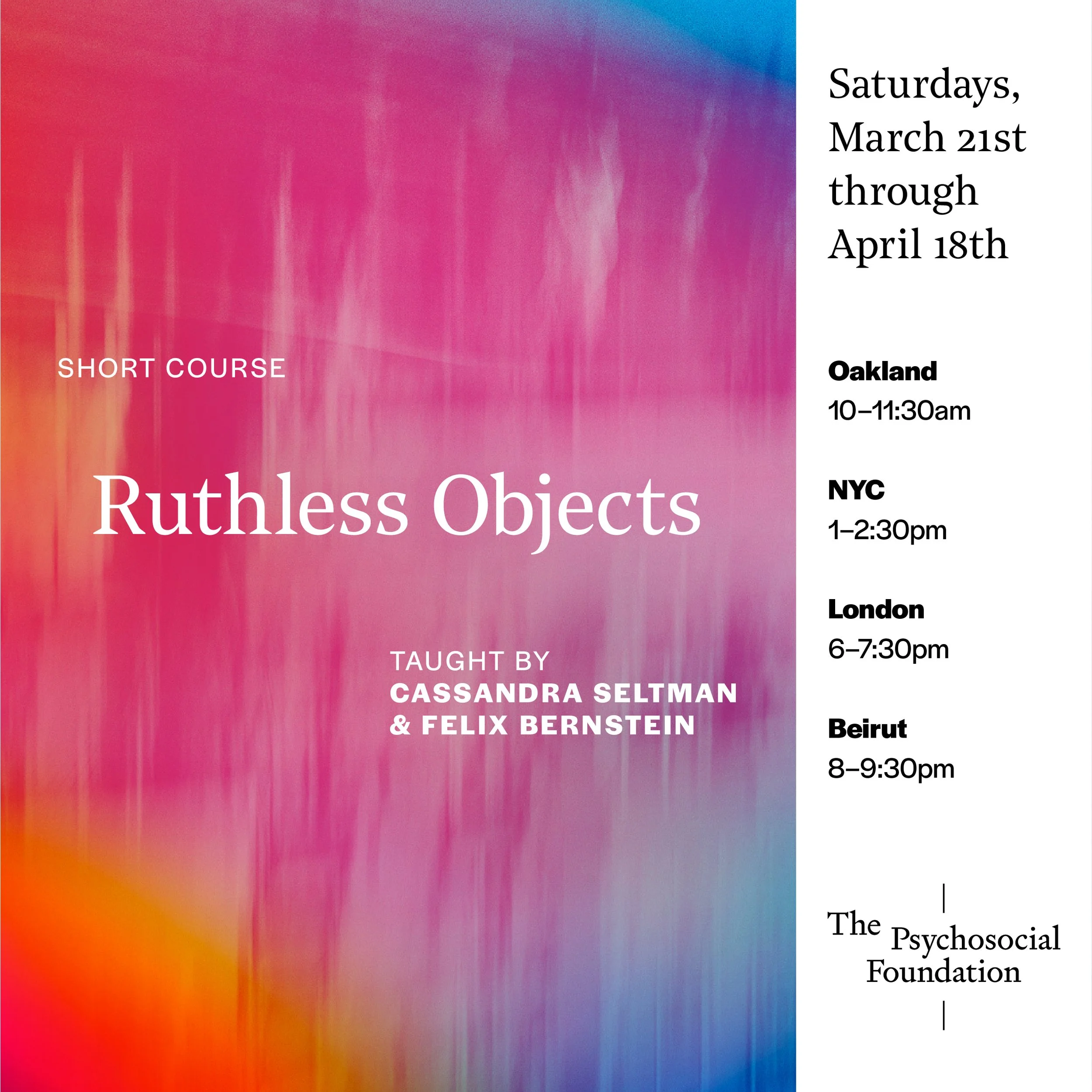
Cassandra Seltman & Felix BernsteinSessions:
Saturdays, March 21-April 19th
10-11:30am Oakland / 1-2:30pm New York / 6pm-730pm London /8pm-930pm Beirut
Online Only
The transitional object is classically pictured as a security blanket or an imaginary friend, something to be shed on the road to maturity. To make a claim of transitionality necessitates a system of progress: from origin (immature) to telos (mature). At the same time, from Charlie Brown to Pee Wee's Playhouse, we find something cute and heartwarming about holding onto these objects, and imagining them with a life of their own.
But what if we get stuck in a transitional space? Or glued to a transitionless object, that perpetually defers any promised closure? Ruthlessly using Winnicott, we sketch a theory of the ruthless object -- a transitional object that is traditionally meant to pivot the child from the family to the social world but becomes a thing-in-itself. This object can be denigrated as a fetish when it persists into adulthood. This thing is not just ruthlessly used by the child, who is said to lack the ability to empathize with the object as a whole, but also ruthlessly uses the child: a blanket that glues itself to the body like a second skin, a gadget that vicariously programs our every move, a safe haven that becomes a prison.
The pressure is on for the "mature" parent or analyst to break the ruthless bond, castrate the child from the thing, and find a way to symbolize the prohibition so the child can graduate out of the literal and into abstraction. Leaving the discourse of child development, we find the same demand manifests in the constant journalistic calls for digital castration, which implicitly tie together stimming, incest, autism, asexuality, adhesion, masturbation, coding and algorithmic conditioning. In a classic trap, the demands to eliminate pre-genital part-objects also betray the ruthless fixations of the disciplinarians and expose a collective fear of confronting the perpetual, transitionless space of fantasy and erotics on its own terms.
Cassandra Seltman LCSW, PhD, is a psychoanalyst, supervisor, and writer in private practice in New York City. She teaches diagnosis in the social work master’s program at Hunter College. Selected publications include the Los Angeles Review of Books, Flash Art, DIVISION/Review, Modern Psychoanalysis, Studies in Gender and Sexuality, the European Journal of Psychoanalysis, May Revue, and Parapraxis.
Felix Bernstein stages psychofictional scenes as lectures, essays, satire, and melodrama, using errant bodies of imagery and discourse to bore holes through crusty ideals. He is the author of Burn Book (Nightboat, 2016) and Notes on Post-Conceptual Poetry (Insert Blanc Press, 2015), which the New York Times noted for its “blistering cultural criticism.” His writing has been featured in Artforum, Art in America, Poetry Magazine, Spike Arts Magazine, Bomb, Mousse, May Revue, Bookforum and Texte Zur Kunst.
Full fee: $450, Reduced fee: $250.
Cassandra Seltman & Felix BernsteinSessions:
Saturdays, March 21-April 19th
10-11:30am Oakland / 1-2:30pm New York / 6pm-730pm London /8pm-930pm Beirut
Online Only
The transitional object is classically pictured as a security blanket or an imaginary friend, something to be shed on the road to maturity. To make a claim of transitionality necessitates a system of progress: from origin (immature) to telos (mature). At the same time, from Charlie Brown to Pee Wee's Playhouse, we find something cute and heartwarming about holding onto these objects, and imagining them with a life of their own.
But what if we get stuck in a transitional space? Or glued to a transitionless object, that perpetually defers any promised closure? Ruthlessly using Winnicott, we sketch a theory of the ruthless object -- a transitional object that is traditionally meant to pivot the child from the family to the social world but becomes a thing-in-itself. This object can be denigrated as a fetish when it persists into adulthood. This thing is not just ruthlessly used by the child, who is said to lack the ability to empathize with the object as a whole, but also ruthlessly uses the child: a blanket that glues itself to the body like a second skin, a gadget that vicariously programs our every move, a safe haven that becomes a prison.
The pressure is on for the "mature" parent or analyst to break the ruthless bond, castrate the child from the thing, and find a way to symbolize the prohibition so the child can graduate out of the literal and into abstraction. Leaving the discourse of child development, we find the same demand manifests in the constant journalistic calls for digital castration, which implicitly tie together stimming, incest, autism, asexuality, adhesion, masturbation, coding and algorithmic conditioning. In a classic trap, the demands to eliminate pre-genital part-objects also betray the ruthless fixations of the disciplinarians and expose a collective fear of confronting the perpetual, transitionless space of fantasy and erotics on its own terms.
Cassandra Seltman LCSW, PhD, is a psychoanalyst, supervisor, and writer in private practice in New York City. She teaches diagnosis in the social work master’s program at Hunter College. Selected publications include the Los Angeles Review of Books, Flash Art, DIVISION/Review, Modern Psychoanalysis, Studies in Gender and Sexuality, the European Journal of Psychoanalysis, May Revue, and Parapraxis.
Felix Bernstein stages psychofictional scenes as lectures, essays, satire, and melodrama, using errant bodies of imagery and discourse to bore holes through crusty ideals. He is the author of Burn Book (Nightboat, 2016) and Notes on Post-Conceptual Poetry (Insert Blanc Press, 2015), which the New York Times noted for its “blistering cultural criticism.” His writing has been featured in Artforum, Art in America, Poetry Magazine, Spike Arts Magazine, Bomb, Mousse, May Revue, Bookforum and Texte Zur Kunst.
Full fee: $450, Reduced fee: $250.